

Electric Gates: A Homeowner's Guide to Types, Motors and Costs in Belfast
You want a gate that opens from the car, but the quotes and motor options are confusing. The wrong choice shows up later as a stuck gate, a drained battery or a repair bill. This guide covers what fits a Belfast driveway and what it costs.
You will learn the difference between swing and sliding gates, which materials suit our weather, and how motors like DEA System and Fadini work. You will also see typical starting prices, the safety standards to check, and how AutoGate Northern Ireland quotes each job after a free site visit.
What Is AutoGate Northern Ireland? Who This Guide Comes From
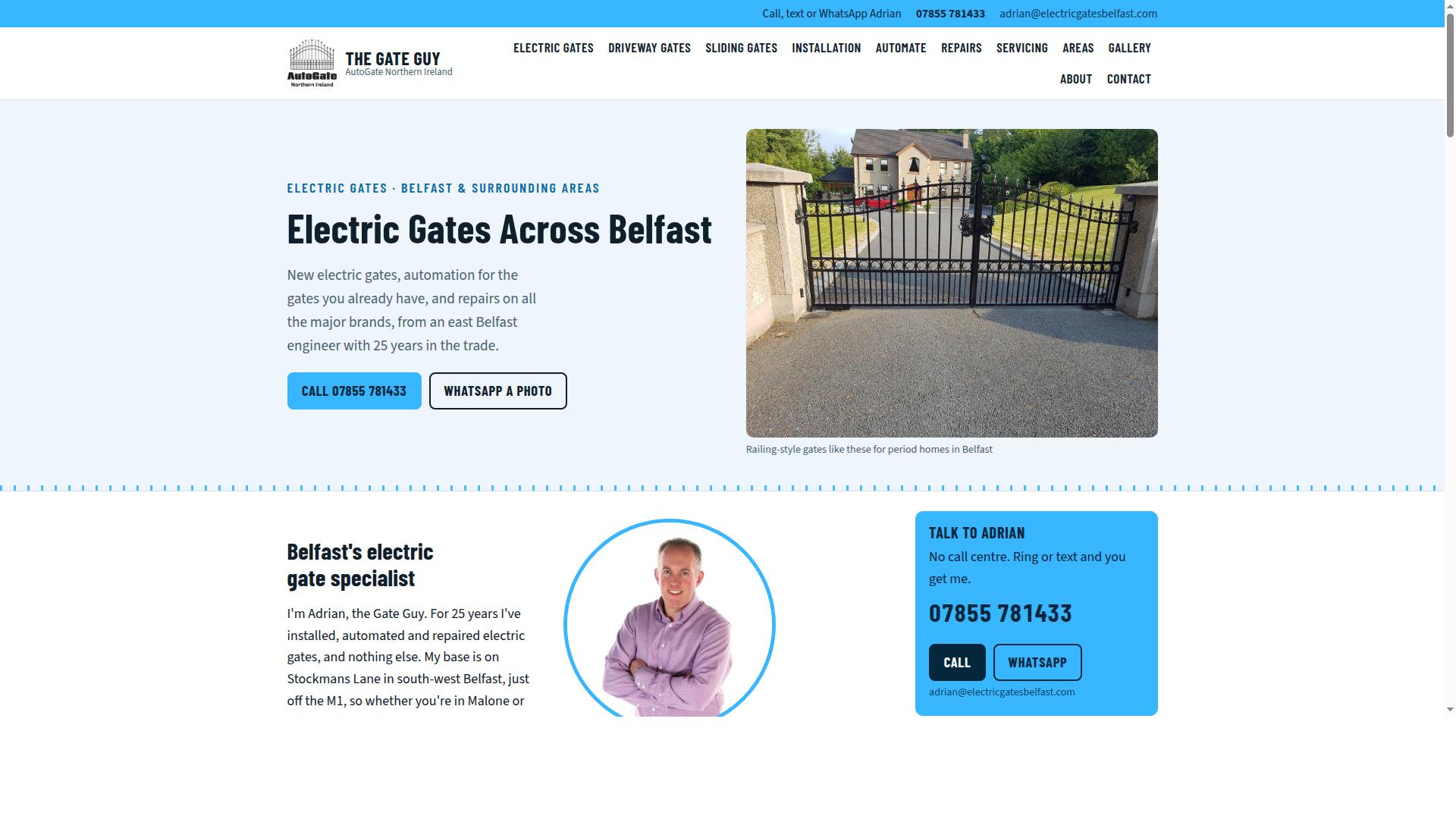
AutoGate Northern Ireland is a Belfast-based electric gate specialist run by Adrian McGivern, known to customers as 'the Gate Guy'. The business is owner-run, which means there is no call centre and no sales team between you and the person doing the work.
Adrian handles every job himself, from the first phone call to the final handover. If you ring with a question about a sticking gate in Bangor or a quote for a new sliding gate in Lisburn, you speak to the engineer who will actually stand in your driveway.
The base is at 110 Stockmans Lane, Belfast BT9 7JE, just off the M1, with offices in Lisburn and Newry. AutoGate Northern Ireland installs, automates and repairs electric gates, and that is the whole of the business. No general building work, no side lines.
Adrian has spent over 25 years in electric gates. He holds a BEng in Electrical Engineering and an MBA from Ulster University, plus City & Guilds qualifications in electrical installation and in inspection and testing.
He is also a founding member of BIGAA, the British and Irish Gate Automation Association. He is the only properly qualified engineer in the electric gate installation industry in Northern Ireland.
Work is carried out to BS EN 12453 for force testing and BS 7671 for electrical installation. Every gate is handed over with a Declaration of Conformity and manuals, and every installation carries a 3-year warranty. Repairs carry 12 months.
This guide comes from that hands-on experience, not from a sales office. The advice on gate types, motor choices and likely costs reflects what Adrian sees on real driveways across Belfast and the surrounding towns. Where a repair isn't worth the money, this guide will say so.
Electric Gate Types for Belfast Driveways
Most Belfast driveways suit one of a handful of gate types, and the right choice depends on slope, space and how you use the entrance. A terraced street in the Holylands has very different needs from a semi in Carryduff or a business entrance off the Boucher Road.
Gate type drives three things: installation costs, which gate motor you need, and what safety kit is required. A gate that swings out over the pavement, for example, needs careful thought about sensors and public safety.
The sections below cover swing, sliding, cantilever, telescopic and bi-fold options so you can match a gate to your own driveway.
Swing Gates: Overground and Underground Motors
Swing gates are the classic driveway gate, and the motor you choose, overground or underground, changes both the look and the cost. Both types open the leaf outward or inward on hinges, and the direction you pick affects which motor fits.
Overground motors sit on the gate post or the gate leaf itself. You will see either an articulated arm motor or a hydraulic ram. They are cheaper to buy, easier to service and simple to replace when they wear out. The trade-off is that they are visible and can look bulky on a tidy front wall.
Underground motors hide in a box set into the ground, so all you see is the gate moving. That clean look costs more to install, because the ground has to be dug out and drained properly. If water pools in the box, the motor will fail early. In a wet Northern Ireland winter, drainage is not optional.
Practical points to weigh up:
- Overground suits most semi-detached and detached driveways in places like Lisburn or Newtownabbey.
- Underground suits period homes and narrow terraced frontages where looks matter.
- Inward opening keeps the gate clear of the pavement, which helps with public safety.
- Outward opening over a footpath needs extra care with safety sensors under BS EN 12453.
Width matters too. A single leaf up to around 2 metres is straightforward. Much wider leaves put more strain on the motor and hinges, so twin leaves often work better. Ask Adrian to check your hinge posts before committing, because a rotten post will fail long before a decent motor does.
Sliding, Cantilevered, Telescopic and Bi-Folding Gates
If you don't have room for a gate to swing open, a sliding gate is usually the answer, but there are several kinds. Most sliding gates run on a rack and pinion drive, which is reliable and easy to maintain.
Standard sliding gates need a track on the ground and clear run-back space along the fence line. On a long detached driveway in Bangor or Hillsborough this works well. On a tight site it simply won't fit.
Cantilever gates hang from a top track with no ground rail, so they cope with sloping or uneven ground and won't jam on gravel or grit. They cost more but suit driveways that fall away from the road.
Telescopic gates use two or more leaves that slide and stack into each other, cutting the run-back space needed. They are a good fit for a narrow Belfast driveway where a standard slider would overshoot the boundary.
Bi-fold gates have leaves that fold back on themselves as they open. They are useful for tight driveways and business entrances where space is short but a wide opening is needed, such as a yard off the Antrim Road.
Each type has a trade-off between space, cost and maintenance. A cantilever or telescopic gate costs more upfront than a simple slider, but it may be the only option that fits. Adrian can measure your run-back and tell you honestly which type your driveway will take.
Gate Materials: Wooden, Wrought Iron and Composite
The material you pick affects how the gate looks, how much maintenance it needs and how heavy it is for the motor. In Belfast, wind and rain do most of the deciding for you.
All three common materials work on automated gates. The trick is matching the material to your budget, your free time and the size of motor you are willing to pay for.
Wooden gates suit period homes and terraces where a bit of character matters. They are repairable, so a rotten board or a damaged stile can be swapped without replacing the whole leaf.
The catch is treatment. In Northern Ireland's damp climate, timber wants a good oil or stain every year or two, otherwise it swells, warps and starts to drag. A dragging gate is hard on the gate opener and can trip the force limitation on a BS EN 12453 compliant control board.
Timber also moves with the seasons, so hinges and latches need checking. If you enjoy a bit of upkeep, wooden driveway gates are a sound choice. If you don't, they will punish you.
Wrought iron is strong, long-lasting and hard to beat for a grand entrance. It shrugs off wind far better than timber and holds its shape for decades.
Two things to know. First, it is heavy, so you need a bigger motor and sturdier posts, which pushes up the electric gate kit cost. Second, bare iron rusts in our wet weather, so it needs painting or powder coating and a touch-up every few years. Check for rust at the bottom rail and around welds.
Composite gates look like timber but are made from a mix of wood fibre and plastic. They don't rot, don't need treating and keep the same colour year after year.
You pay more upfront, and very cheap composite can fade or look a bit flat up close. It is also heavier than you might expect, so motor sizing still matters. For a busy household that wants low maintenance, it is often the sensible middle ground.
| Material | Maintenance | Weight | Best for |
|---|---|---|---|
| Wooden | Treat yearly or two-yearly | Moderate | Traditional look, repairable |
| Wrought iron | Paint or powder coat every few years | Heavy | Long life, strong entrance |
| Composite | Occasional clean only | Moderate to heavy | Low fuss, consistent finish |
Whichever you choose, the motor must be matched to the real weight of the finished leaf, not a guess. An undersized motor on heavy gates will strain, overheat and fail early. Get the weight right at the design stage and the gate automation will last far longer.
Gate Motors Explained: DEA System and Fadini Hydraulics
Most gate motors fall into a few families, and the two Adrian fits most often are DEA System electromechanical motors and Fadini hydraulic rams. Both are well known in the trade and both do a solid job, but they suit different gates and different habits.
Here is the simple difference. An electromechanical motor turns a motor and gears to move the gate. A hydraulic motor pushes a ram using oil pressure. That is the whole idea, and everything else follows from it.
Neither is "better" in a general sense. The right one depends on your gate, your drive and how often the thing opens. A good installer picks the motor to match the gate, not the other way round.
Electromechanical motors are the common choice for sliding gates and swing gates. Inside, a motor drives gears, and on sliding gates that usually means a rack and pinion setup running along the gate. Swing gates often use an articulated arm motor or an underground motor tucked in a box at the hinge.
Many of these run on 24V. That is a low-voltage motor, and it generally moves more smoothly and is gentler if the gate meets an obstacle. It also lets the control board keep a close eye on force, which matters for safety.
There are heavier-duty versions too, including worm drive motors for bigger sliding gates. They are slower but strong and hold their position well on a slope.
DEA System motors are a familiar sight on domestic driveways around Belfast. They are tidy, well supported for spares, and fine for most swing and sliding setups.
Fadini hydraulic rams use oil pressure instead of gears. Think of a digger arm rather than a gearbox. They are strong, quiet in use, and cope well with heavy gates and gates that open many times a day.
They also hold up well in damp, coastal weather, which is worth thinking about in places like Bangor or Carrickfergus. Fewer exposed gears means less to gum up with grit and salt.
The trade-off is cost and servicing. Hydraulic units tend to cost more up front, and the oil and seals need checking over the years. If a ram starts weeping oil, it needs attention rather than a bit of tape.
For a light domestic gate that opens twice a day, a hydraulic ram is often more than you need. Adrian will say so rather than sell you one.
Control panels come in 230V mains and 24V low-voltage versions. Both are common and both are safe when installed properly to BS 7671, the wiring regulations.
The 24V route is popular because the low voltage at the gate itself is kinder for safety sensing. It also opens the door to a solar gate motor setup, which suits sites with no mains power, such as a farm entrance or a lane outside a village.
A 230V panel is straightforward where power is already at the gate and the run is short. Either way, the panel needs a proper supply, an isolator and the right earthing. That is not a job for a DIY spur off the shed.
Motor choice follows three things: gate weight, gate width and how often it opens. A wide, heavy swing gate on a windy hill needs more motor than a light driveway gate in a sheltered street.
Usage matters just as much. A gate that opens a handful of times a day is a different job from one on a busy family drive with deliveries and visitors all day.
Whatever the motor, the finished job must meet BS EN 12453. In plain terms, that means force limitation plus safety sensors such as photocells, infrared beams and safety edges. A motor without those is not a safe automated gate.
If your existing gate has no sensors, that is the first thing to sort, before any talk of a new motor.
What Electric Gates Cost in Belfast
Electric gate prices in Belfast vary with gate size, motor type and whether you're automating an existing gate or starting from scratch. There's no single figure that fits every driveway.
What you can do is use starting prices as a guide. They tell you roughly what a job of each kind begins at, so you can plan before anyone calls out.
The two sections below give the figures and explain why a proper quote only comes after someone has stood in your driveway. A photo rarely tells the whole story.
Starting Prices for Automation and New Gates
As a guide, AutoGate Northern Ireland's starting prices are £1,400 for sliding gate automation and £1,800 for overground swing gate automation. These cover automating a gate, not supplying a new one.
Underground swing gate automation starts from around £2,400, because the motors sit in the ground and the groundwork adds to the job. Heavy-duty hydraulic automation, such as Fadini, is priced on survey.
If you need new gates as well, those are quoted separately. As a rough guide:
- Wooden gates from £1,600
- Wrought iron gates from £2,000
- Composite gates from £2,200
Combined jobs give a better picture. Wooden gates with overground motors start around £3,400, a composite sliding gate with sliding automation around £3,600, and wrought iron gates with underground motors around £4,400.
Treat all of these as starting points, not fixed quotes. Access, groundworks and the electrical supply can all add cost, and final price depends on gate size, design and materials.
Why Every Job Is Quoted After a Free Site Visit
A gate that looks simple on a photo can hide a slope, a weak post or no power supply, so every job is quoted after a free site visit. Adrian would rather see it than guess.
On the visit he checks a few practical things:
- The weight and width of the gate, and whether the existing posts are sound
- Ground slope and how the gate needs to swing or slide
- The cable route and where power will come from
- How you want to open it, whether by remote control, keypad entry or intercom
This matters for safety as much as cost. Gates are force tested to BS EN 12453 and electrical work is done to BS 7671, and neither can be done properly without knowing the site. It also means the quote you get is the price you pay, with no surprises halfway through.
The visit is free with no obligation, and covers Belfast and the towns around it, including Lisburn and Newry. If a repair isn't worth doing, Adrian will tell you that too.
Safety, Standards and Warranties to Check Before You Buy
Any electric gate you buy should be force tested to BS EN 12453 and have its electrical work done to BS 7671, and you should get the paperwork to prove it. Those two standards are the difference between a gate that stops when it meets a child and one that keeps pushing.
Ask for the evidence before you pay a deposit. A proper installer will hand it over without fuss. If someone dodges the question, walk away.
BS EN 12453 is the safety standard for powered gates. In plain terms, it means the gate must limit how hard it pushes and must have devices that spot an obstruction. Those devices are usually photocells (infrared beams across the opening) and safety edges on the gate leaf itself.
Force limitation means the motor senses resistance and reverses or stops. On a Belfast driveway with kids and pets about, this matters more than any remote control feature.
BS 7671 is the wiring regulations for electrical installations in the UK. It covers how the gate's power supply, earthing and cabling are installed and tested. A qualified electrician works to this standard and leaves test results behind.
Adrian at AutoGate Northern Ireland is a Belfast based electric gate engineer. He holds a BEng in Electrical Engineering, an MBA from Ulster University, and City & Guilds in electrical installation and in inspection and testing. Every installation he completes is force tested to BS EN 12453 and wired to BS 7671.
At handover you should receive a Declaration of Conformity and the manuals for the gate, motor and control board. The declaration is your written record that the installation meets the standards. Keep it with your house documents, as it is useful if you ever sell the property.
Manuals matter too. They tell you how to use the manual release, which every gate should have, and how to look after the automation. If a fitter cannot produce these documents, the job is not finished properly.
On warranties, look for a clear written term. AutoGate Northern Ireland gives a 3-year warranty on all installations and a 12-month warranty on all repairs. That split is sensible: a new installation carries the longer cover, while repair work is backed for a year.
Ask any installer what happens if a motor fails in year two, and who pays for the call-out. A vague answer now becomes an argument later. Also check they hold public and employers' liability insurance, which AutoGate Northern Ireland does.
Be wary of cheap electric gate kits sold online and fitted by someone doing it as a sideline. The saving is often swallowed by missing safety devices, poor wiring or a gate that cannot be made compliant. An unsafe automated gate is a real hazard, not a bargain.
Membership of a trade body is a useful filter. BIGAA, the British and Irish Gate Automation Association, is the relevant one for this trade. Adrian is a founding member, which shows his commitment to safe installation.
Ask to see qualifications and association membership before work starts. A proper installer will be glad you asked.
Who Should Use AutoGate Northern Ireland
AutoGate Northern Ireland suits homeowners who want a safe, convenient driveway gate and business owners who need a reliable entrance. Adrian is Belfast based and deals with every customer himself, so you speak to the person who will actually do the work. There is no call centre and no passing you around.
Most enquiries fall into four groups. See which one sounds like you:
- Homeowners adding electric gates for safety and convenience, whether that is a short city driveway in BT9 or a longer lane outside Lisburn or Newry.
- Business owners automating an entrance, including commercial gates for staff, deliveries and visitors.
- Homeowners with a broken gate that needs repairing, any make and whoever installed it.
- Homeowners with a manual gate they would like automated, from swing and sliding gates to bi-fold and cantilever designs.
Adrian installs DEA System and Fadini motors. On the repair side he works on Beninca, CAME, FAAC, BFT, Nice, SEA, Gibidi, Allmatic, V2, Key Automation and Chamberlain LiftMaster, as well as DEA and Fadini. If your gate was fitted by someone else, that is not a problem.
Farms and country homes with long lanes are well looked after, and so are period homes where the gate needs to match the house. Every installation is force tested to BS EN 12453 and the electrics are wired to BS 7671. You get a Declaration of Conformity and the manuals at handover, and there is a manual release on every gate.
Honest advice matters more than a sale. If a motor is tired but the gate itself is sound, a repair or replacement motor usually makes sense. If the frame is twisted, the posts are moving or the gate has been unsafe for years, Adrian will tell you straight that a repair is throwing good money after bad. A new gate and automation may cost less over time than repeat call-outs.
Installations carry a 3-year warranty and repairs carry 12 months. Quotes are free with no obligation and always follow a site visit, so the price fits your gate, not a guess over the phone. Whether you are in Belfast, Lisburn, Newry or the towns around them, you deal with Adrian from first call to handover.
Final Verdict
If you want straight advice and a proper job from someone who installs and repairs electric gates every day, AutoGate Northern Ireland is worth a call. Adrian runs the business himself, so you deal with the person doing the work, not a call centre.
He has spent over 25 years in electric gate installation and repair. That matters when you are weighing up gate types, motors and costs for a home in Belfast, because you get honest guidance rather than a sales pitch.
The safety side is taken seriously. Every installation is force tested to BS EN 12453, electrical work follows BS 7671, and you get a Declaration of Conformity and manuals at handover. Adrian is a founding member of BIGAA, the British and Irish Gate Automation Association, and carries public and employers' liability insurance.
On qualifications, he holds a BEng in Electrical Engineering and an MBA from Ulster University, plus City & Guilds in electrical installation and in inspection and testing. He is the only properly qualified engineer in the electric gate installation industry in Northern Ireland.
Prices are starting prices, and every job is quoted after a free site visit with no obligation:
- Sliding gate automation from £1,400
- Overground swing gate automation from £1,800
- Underground swing gate automation from around £2,400
- Wooden gates from £1,600, wrought iron from £2,000, composite from £2,200
- Heavy-duty Fadini hydraulic automation priced on survey
Warranty is 3 years on all installations and 12 months on all repairs. He installs DEA System and Fadini, and repairs Beninca, CAME, FAAC, BFT, Nice, SEA, Gibidi, Allmatic, V2, Key Automation and Chamberlain LiftMaster, whoever fitted them.
If your gate is beyond economic repair, he will tell you so rather than push a new kit. That is the kind of honest verdict a homeowner in Belfast actually needs.
To get things moving, call, text or WhatsApp 07855 781433. You can also email adrian@electricgatesbelfast.com. The address is 110 Stockmans Lane, Belfast BT9 7JE, just off the M1, with offices also in Lisburn and Newry. The website is electricgatesbelfast.com.
Frequently Asked Questions
How much does electric gate automation cost in Belfast?
At AutoGate Northern Ireland, sliding gate automation starts from £1,400 and overground automation for swing gates from £1,800, while underground automation starts from around £2,400. New gates are also available, from £1,600 for wooden and £2,200 for composite. Every job is quoted after a free, no-obligation site visit, as the final price depends on gate size, design and materials.
Which types of electric gates can AutoGate Northern Ireland install?
AutoGate Northern Ireland installs swing, sliding, cantilevered sliding, telescopic sliding and bi-folding gates, including bi-folding for tight driveways and heavy-duty hydraulic automation for large or heavy gates. New gates are made to measure in wrought iron, wood or composite and can be automated from the start. Adrian also automates existing manual gates and repairs electric gates of all types and makes.
Can you repair my existing electric gate, even if another company installed it?
Yes. AutoGate Northern Ireland repairs gates whoever installed them, covering brands including Beninca, CAME, FAAC, BFT, Nice, SEA, Gibidi, Allmatic, V2, Key Automation and Chamberlain LiftMaster, as well as DEA and Fadini. Sending a photo or short video of the gate, motor and control box labels helps diagnose the fault before a visit. All repairs come with a 12-month warranty.
What warranty and safety standards come with an AutoGate Northern Ireland installation?
Every installation carries a 3-year warranty, and every gate is force tested to BS EN 12453 with electrical work to BS 7671. At handover you receive a Declaration of Conformity and manuals, and every gate has a manual release, with battery backup available. Adrian is a founding member of BIGAA, the British and Irish Gate Automation Association, and the business is fully insured.
Who will I deal with, and which areas do you cover?
You deal directly with owner Adrian McGivern (BEng, MBA), a Belfast based electric gate engineer with over 25 years in the industry, from first visit to handover, with no call centre. AutoGate Northern Ireland is based at 110 Stockmans Lane, Belfast BT9 7JE, just off the M1, with offices in Lisburn and Newry. Coverage includes Belfast and surrounding towns such as Lisburn, Newry, Bangor, Newtownards, Armagh, Portadown, Dungannon, Hillsborough, Banbridge and Downpatrick.
Can I open my electric gates from my phone?
Yes. AutoGate Northern Ireland offers access control options including remotes, keypads, intercoms, fobs, phone/app control (Alexa and Google Home) and GSM call-to-open. The right setup depends on your gate and how you want to use it, and it can be discussed during your free site visit. Call, text or WhatsApp 07855 781433 to arrange one.